
MolmoAct2: Action Reasoning Models for Real-world Deployment

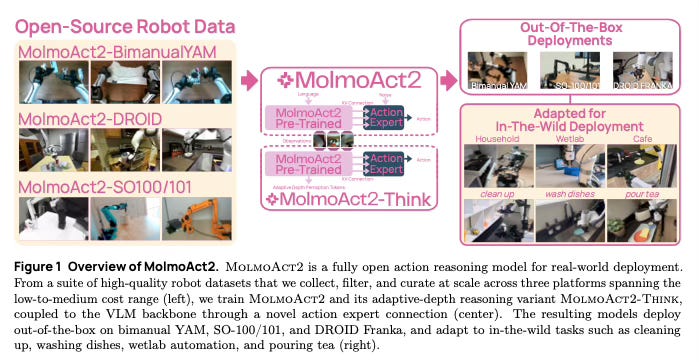
Today’s paper addresses the limitations of current vision-language-action (VLA) models in robotic control, which often suffer from being closed-source, reliant on expensive hardware, or too slow for practical deployment due to heavy reasoning requirements. The paper introduces MolmoAct2, a fully open-source action reasoning model designed for real-world robotics. The model provides a generalist controller capable of handling diverse tasks across different robotic platforms by improving spatial understanding, reasoning efficiency, and out-of-the-box deployability.
Method Overview
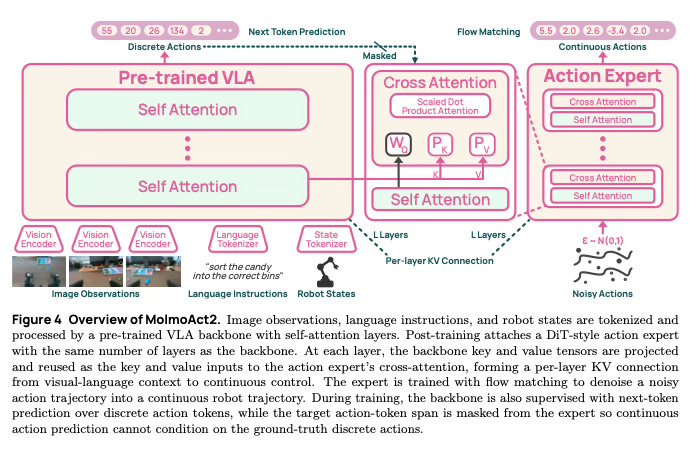
The method relies on a three-stage training pipeline that connects a powerful vision-language model with a continuous robot control module. Initially, the system starts with a vision-language backbone trained specifically to understand spatial relationships and physical environments. This backbone is then taught to predict robot actions as simple, discrete text-like tokens, allowing it to seamlessly blend robot training data with general web and image data. Finally, a specialized action expert is attached to this backbone to translate the model’s understanding into smooth, continuous physical movements.
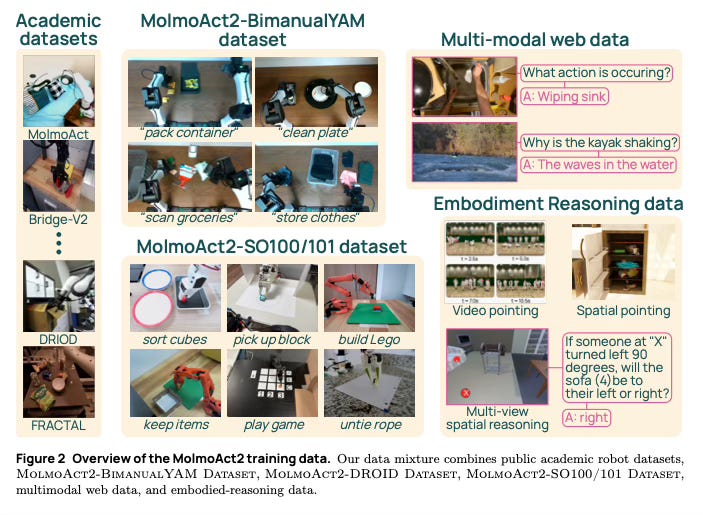
To build a strong foundation for physical tasks, the paper introduces Molmo2-ER, a vision-language backbone specialized in embodied reasoning tasks like pointing, estimating depth, and tracking objects across multiple camera views. To connect this visual understanding to robotics, the method uses an open-source tokenizer to compress continuous robot trajectories into compact discrete tokens. This allows the model to process robot actions exactly like it processes text, making large-scale training highly stable.
Instead of executing jerky, discrete actions in the real world, the final system attaches a continuous action expert that learns a smooth flow of movements. A central feature of this connection is that the action expert pulls information from every single layer of the vision-language backbone, giving it a deep, hierarchical understanding of the visual scene. Furthermore, the paper introduces a variant called MolmoAct2-Think, which adds an adaptive depth perception step. Before moving, the model predicts the 3D layout of the scene in the form of depth tokens. To save time, it only recalculates the depth for areas of the scene that have actually changed from the previous moment, reusing the layout for static objects. This drastically speeds up the reasoning process while maintaining high geometric accuracy.
Results
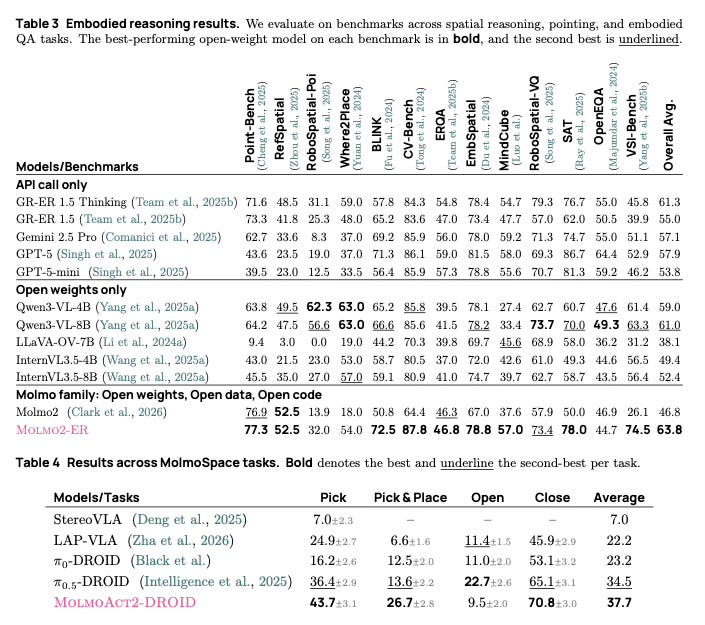
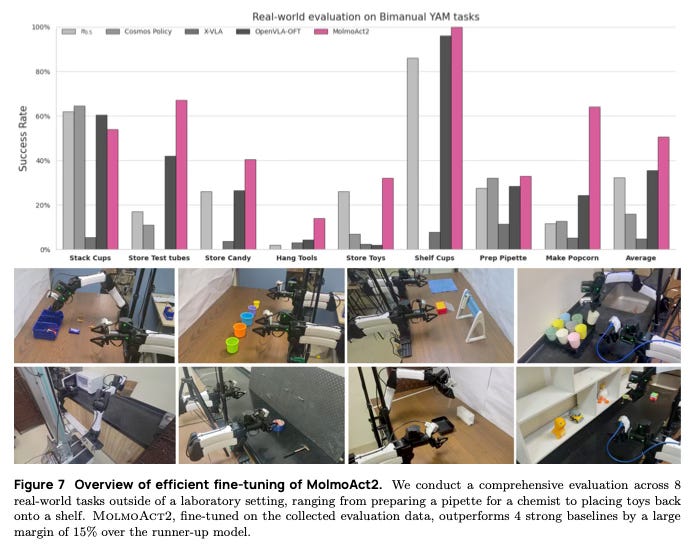
The paper conducts extensive evaluations across multiple simulated and real-world benchmarks. The core vision-language backbone, Molmo2-ER, outperforms major proprietary and open-weight models on 9 out of 13 embodied reasoning tasks. In zero-shot out-of-the-box deployment, MolmoAct2 surpasses strong baseline models on multiple simulation platforms and achieves high success rates on challenging real-world tasks using varied robotic setups, including low-to-medium cost embodiments. When fine-tuned on new tasks, MolmoAct2 reaches an average success rate of 97.2% on the LIBERO simulation benchmark and shows a 15% improvement over the runner-up on a comprehensive suite of real-world evaluation tasks. Additionally, the adaptive depth reasoning in MolmoAct2-Think improves overall task success while significantly increasing the inference speed compared to models that re-evaluate the entire scene at every step.
Conclusion
In summary, the paper presents MolmoAct2, a fully open, highly capable vision-language-action model tailored for practical robotic deployment. By combining a spatially aware vision-language backbone, a layer-wise action expert connection, and an adaptive depth-reasoning mechanism, the model achieves state-of-the-art performance across a wide range of robotics benchmarks. The release of its weights, training code, and extensive datasets provides a strong foundation for future robotics research and real-world integration.
For more information please consult the full paper.
Congrats to the authors for their work!
Fang, Haoquan, and Jiafei Duan, et al. “MolmoAct2: Action Reasoning Models for Real-World Deployment.” arXiv preprint arXiv:2605.02881 (2026).