
Paper2Rebuttal: A Multi-Agent Framework for Transparent Author Response Assistance

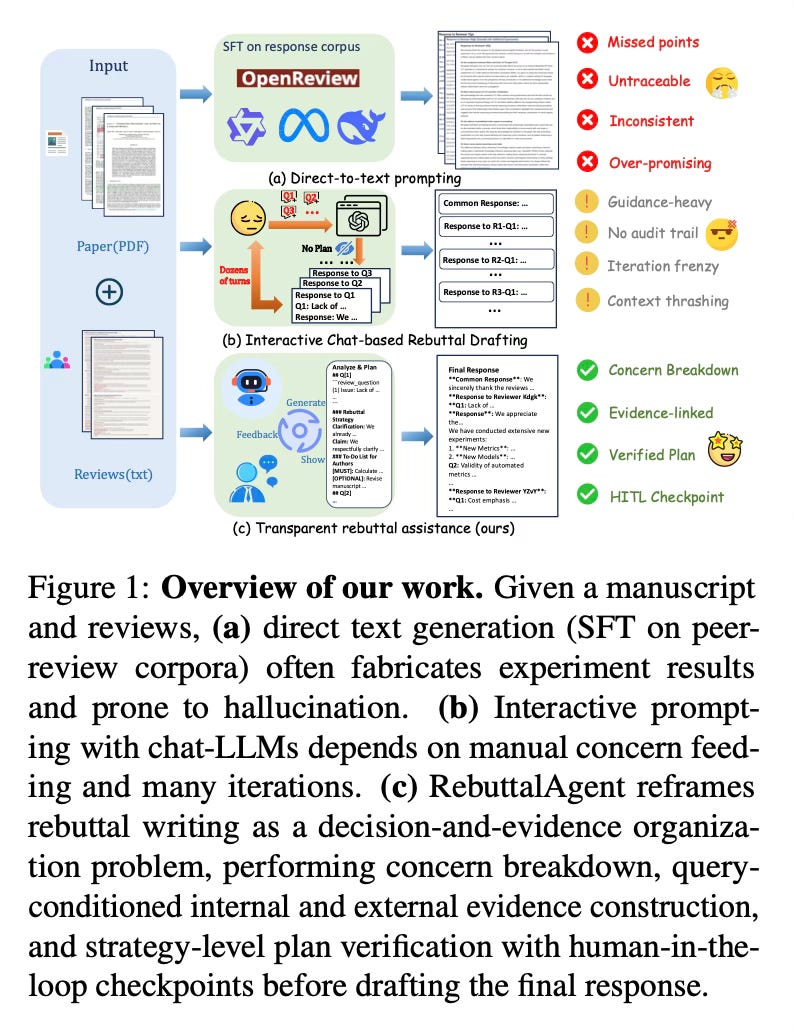
Today’s paper addresses the complex and high-stakes challenge of writing rebuttals during the scientific peer review process. Authors often face tight deadlines and must produce responses that accurately decipher reviewer intent while strictly anchoring arguments in verifiable manuscript details. While Large Language Models have been applied to this task, current approaches often suffer from hallucinations, overlooked critiques, or a lack of transparency. The paper introduces REBUTTALAGENT, a multi-agent framework that reframes rebuttal generation as an evidence-centric planning task to improve reliability and controllability.
Method Overview
The method approaches the task of writing a rebuttal by mimicking a structured human workflow rather than attempting to generate the text in a single pass. Instead of rushing to draft a response, the system treats the problem as one of decision-making and evidence organization. It first breaks down the reviewers’ feedback into specific points, gathers the necessary proof from the paper or external sources, and outlines a strategy. This “verify-then-write” approach ensures that the final output is not just fluent, but also accurate and grounded in the actual content of the research.
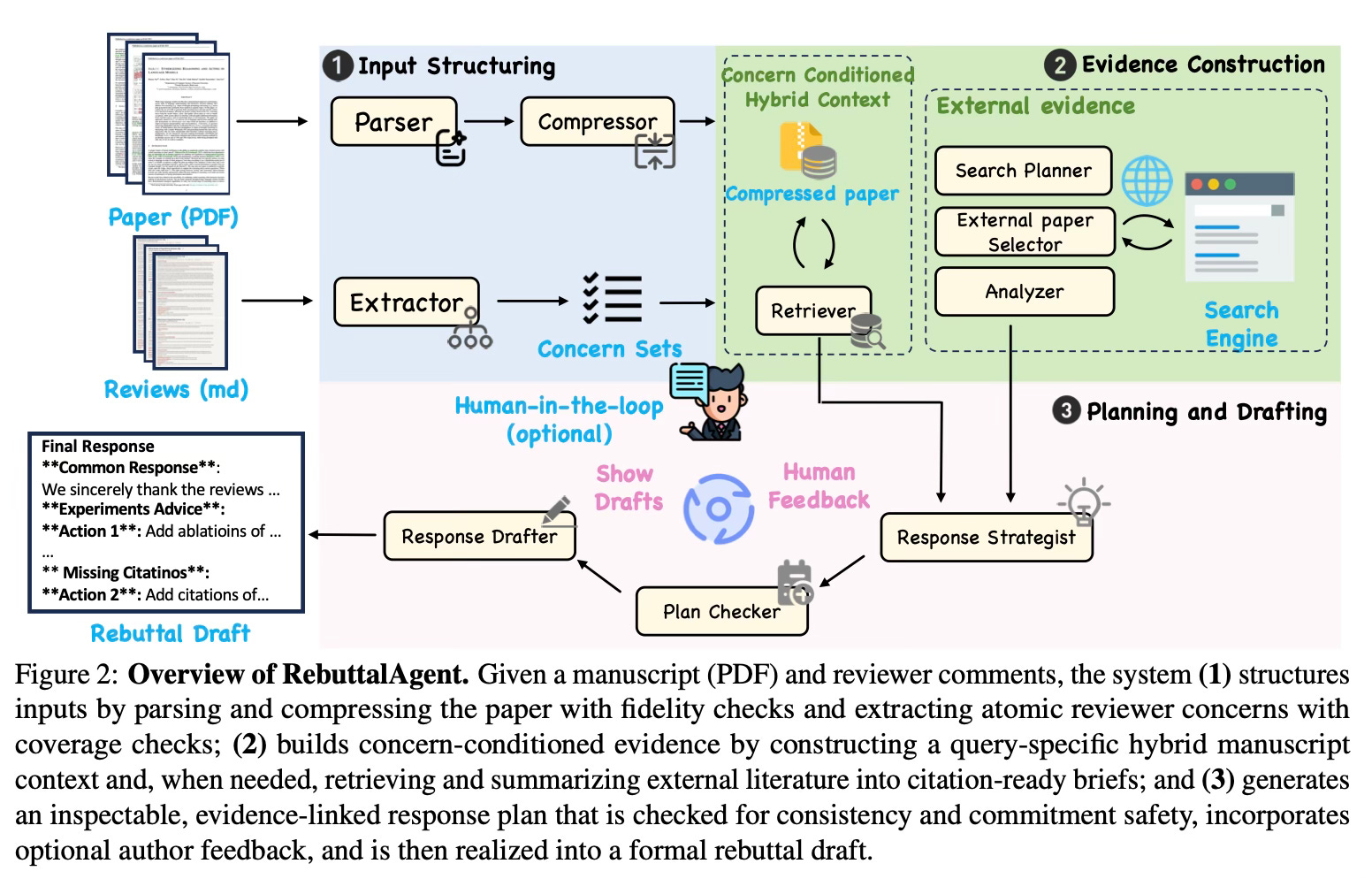
The pipeline begins by decomposing unstructured review text into atomic, discrete concerns to ensure comprehensive coverage of all critiques. Once the concerns are identified, the system engages in a dual-source evidence construction phase. It synthesizes relevant passages from the manuscript to address internal questions and employs an autonomous external search module to retrieve outside literature for concerns requiring broader context. This ensures that the information used to formulate the response is high-fidelity and directly relevant to the specific points raised.
Crucially, the framework includes a strategic planning stage that occurs before any final text is drafted. The system generates an inspectable response plan that outlines the arguments and evidence to be used. This allows for an audit of global consistency, ensuring that concessions or claims made to one reviewer do not contradict the overall stance of the paper. By incorporating human-in-the-loop checkpoints, the method allows authors to verify the concern breakdown and the proposed strategy, making the process transparent and keeping the author in control of the scientific defense.
Results
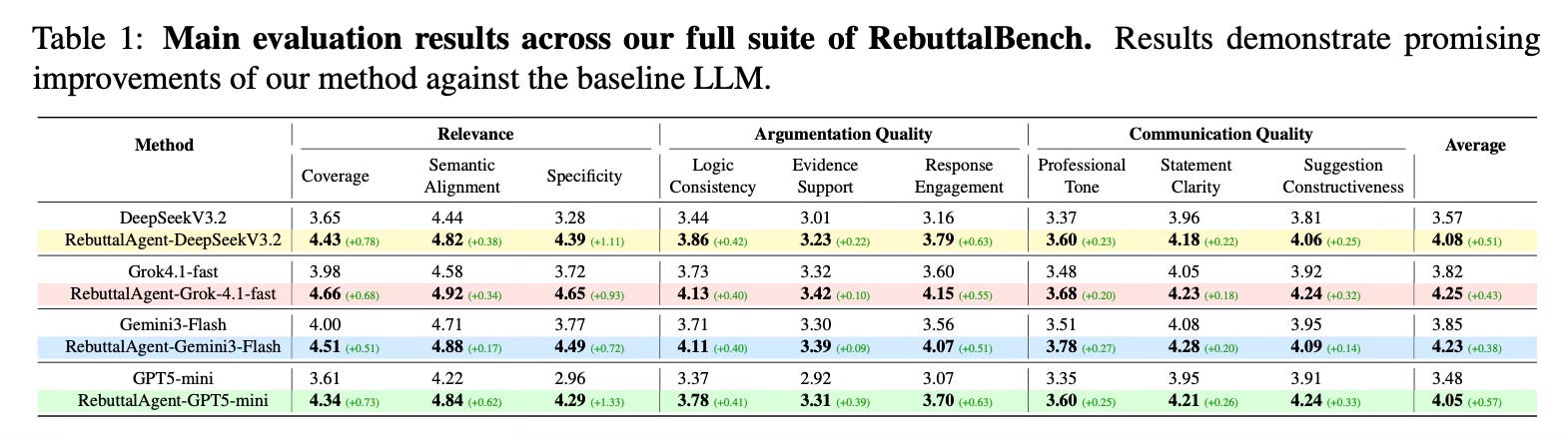
The paper evaluates the framework on a newly constructed benchmark named REBUTTALBENCH. The assessment prioritizes practical utility through dimensions such as the coverage of reviewer concerns, the faithfulness of the content, the traceability of evidence sources, and the global coherence of the arguments. The results indicate that the proposed pipeline consistently outperforms strong baselines, including direct-to-text generation models and standard interactive chat-LLMs. The system demonstrates a superior ability to produce responses that are strictly grounded in evidence and strategically consistent, effectively reducing the risk of hallucinated experimental results.
Conclusion
In summary, the paper presents a robust solution for automated rebuttal assistance that moves beyond simple text generation. By decoupling the reasoning and planning phases from the drafting phase, the framework ensures that responses are comprehensive, verifiable, and aligned with the manuscript. It offers a transparent tool for authors to navigate the peer review process with greater confidence and efficiency.
For more information please consult the full paper.
Congrats to the authors for their work!
Ma, Qianli, et al. “Paper2Rebuttal: A Multi-Agent Framework for Transparent Author Response Assistance.” arXiv preprint arXiv:2601.14171 (2026).